Oneida Nation Collaboration
Learn more about Oneida Community Advisory Board, from member, Florence Petri!
Oneida Community Advisory Board
Specific Aim 1: Continue the Oneida Alzheimer’s and Related Dementias Community Advisory Board “Oneida Alzheimer’s CAB” to guide a culturally tailored outreach, education and research.
Specific Aim 2: Reach middle-aged adults, military Veterans and youth with Dementia Curriculum.
Specific Aim 3: Work to reduce stigma associated with Alzheimer’s and Related Dementias by providing outreach and education.
Specific Aim 4: Continue efforts to optimize access to culturally competent dementia diagnostics.
Research collaboration
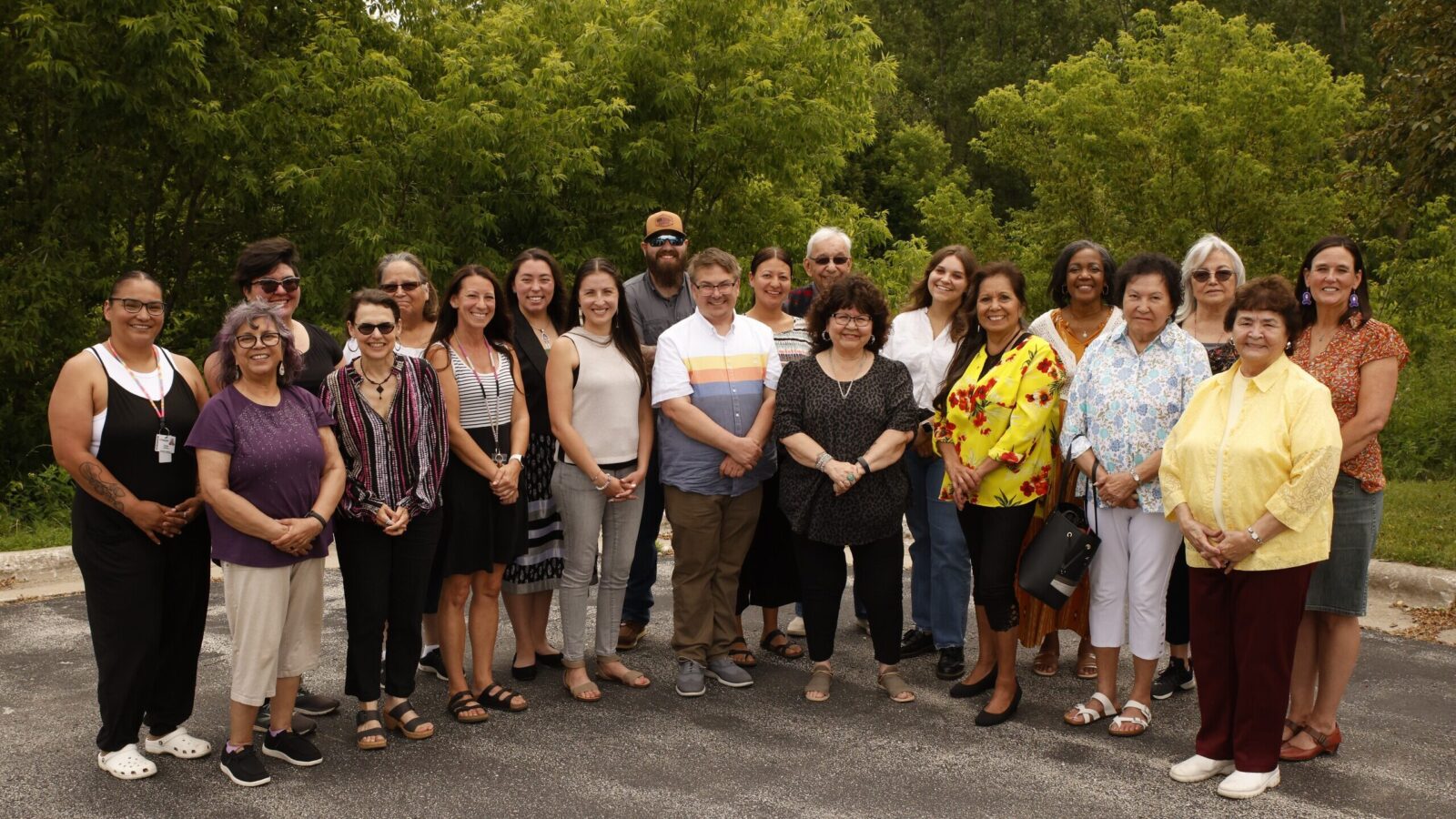
UW scientists are encouraged to seek input from the Oneida Community Advisory Board (CAB). Board members are available to review and advise on studies to help them be more inclusive of Indigenous people and ensure results from research are more relevant to diverse populations.
If you have questions about our program and would like to reach Oneida CAB, please email Lexi Nelson at lnelson@medicine.wisc.edu and Tracy Smith at tmsmith6@wisc.edu.
Oneida Helping Oneida
Family and friends play an essential role in the care system for Elders with dementia. Family caregivers can often benefit from training, support groups, and other services to help them in their role. The Oneida Nation has a number of such resources available. However, the Oneida Alzheimer’s Disease Community Advisory Board identified that many caregivers do not utilize these services. The Oneida Helping Oneida Family Caregiving Study used a community-wide survey and qualitative interviews to better understand factors impacting use of caregiving resources in the Oneida Nation. The goal was to help Oneida and other Indigenous communities develop effective initiatives to increase the use of caregiver services. Supported in part through a pilot grant from UW ICTR (https://ictr.wisc.edu/funding/), the study was conducted within a tribally-led, community-based participatory research framework. Community members worked alongside UW researchers to develop measures, conduct recruitment and data collection, and analyze and interpret findings. Results have been shared widely through a Community Report and public talks, and with other researchers through presentations at AAIC, GSA and caregiving research conferences.
The first publication focused on using survey data (N=481) to identify factors associated with awareness of seven key caregiver services and explore participant perspectives on how service use aligns with traditional cultural values. The study found that caregiving was common, as nearly half of the participants were current caregivers, most helping an Elder and or a person experiencing memory loss. Current caregivers, older adults, and people living within reservation boundaries had greater awareness. Perceptions of whether resource use was consistent with traditional cultural values varied by resource type. The findings highlight the need for culturally-relevant outreach and support programs to improve resource utilization among family caregivers.
Study PI: Mary Wyman, PhD (Mentor: Carey Gleason, PhD)
Publications
“Awareness of family caregiver resources and alignment with traditional culture in a Midwest tribal nation in the United States”
Wyman, M.F., Lennon, D.B., Montoure, J., McLester-Davis, L.W.Y., Hammock, C., Lambrou, N., Lawrence, S., Miller, D.A., Petri, F., Zuelsdorff, M., & Gleason, C.E. (2026). Awareness of family caregiver resources and alignment with traditional culture in a Midwest Tribal Nation in the United States. Journal of Community Health. https://doi.org/10.1007/s10900-026-01589-4